 419-227-8742
 twistedbars@aol.com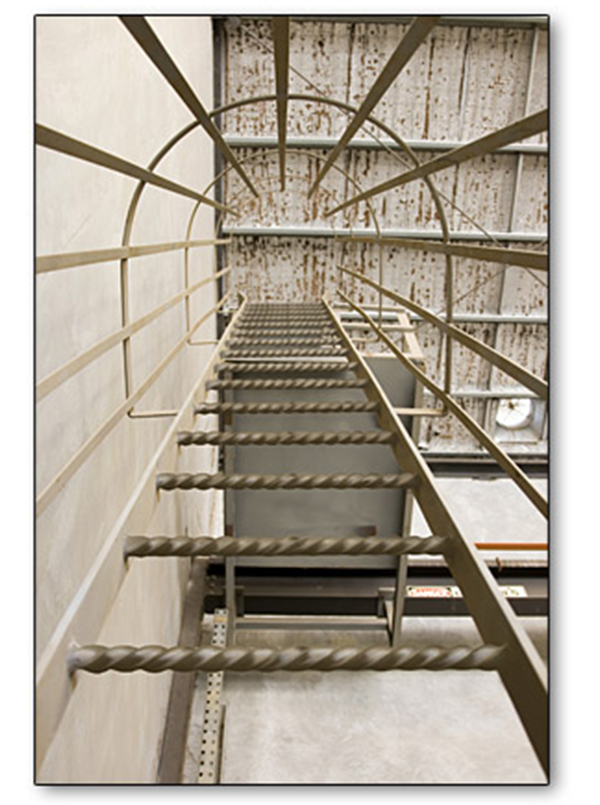
Twisted Ladder Rungs
Twisted ladder rungs are metal components designed to improve grip and slip resistance through a continuous spiral surface. The added texture helps provide secure footing in ladder systems, platforms, and other access points.
- Available in Aluminum, Steel, or Stainless Steel
- Sizes of 3/4″, 7/8″, 1″ and 1 1/4″
- Used in cage ladders, platforms and industrial access systems
- Custom twist profiles & lengths available
- Supplied raw, ready for paint or powder coating
- 100% Made in the USA
Need pricing or product guidance?
Request a quote and our team will help you find exactly what you’re looking for, including custom sizes and configurations.
Engineered Access Components with Strength and Consistency Using Twisted Ladder Rungs
Industrial access systems depend on components that deliver predictable performance under repeated use. Manufactured from solid metal stock, Twisted Ladder Rungs are designed to provide reliable footing, consistent spacing, and long-term durability in fixed ladder and access applications. Their primary purpose is functional—supporting safe movement, load transfer, and structural consistency within demanding environments.
The twisted profile is not ornamental by intent. Instead, it increases rigidity and grip while helping maintain straightness and repeatable geometry across installations. In contemporary fabrication, Twisted Ladder Rungs are specified where reliability, alignment, and serviceability are non-negotiable.
Where Metal Ladder Rungs Are Commonly Used
Across industrial and utility-focused projects, Metal Ladder Rungs are used wherever controlled access and secure footing are required. Common applications include fixed ladders, service access systems, mezzanine connections, equipment platforms, maintenance structures, and custom-built access frameworks. In these systems, Ladder Rungs establish consistent spacing and dependable support under load.
Because of their uniform profile, Metal Ladder Rungs function as reference components, allowing surrounding frames and stringers to remain aligned and evenly spaced throughout the assembly.
Structural Placement and Functional Demand
Performance is driven by geometry and placement. When installed in vertical, inclined, or offset configurations, Twisted Ladder Rungs manage load while maintaining secure footing and predictable attachment points. Their form supports repeatable spacing and controlled installation, reducing variability across multi-rung systems.
In coordinated assemblies, Ladder Rungs contribute to overall structural stability without introducing unnecessary mass or complexity, making them well suited for compact or space-constrained access designs.
Functional Characteristics of Twisted Ladder Rungs
From a performance standpoint, Twisted Ladder Rungs are defined by strength, grip, and consistency. The twisted form increases stiffness and traction while maintaining a clean, utilitarian silhouette. Any visual variation introduced by the twist is incidental to function rather than a design objective.
Industrial ladder rungs are used wherever secure footing, consistent spacing, and long-term durability are required in access systems, with performance and reliability remaining the primary criteria.
Material and Fabrication Considerations
Rungs are produced from solid stock to maintain straightness and dimensional accuracy across demanding applications. Metal Ladder Rungs are available in steel, and stainless steel, allowing fabricators to select materials based on load requirements, environment, and long-term performance expectations. This ensures Twisted Ladder Rungs remain consistent across interior and exterior installations.
Finishes are typically applied later in the fabrication process as required by the project environment. Regardless of finish, Ladder Rungs retain their geometry and structural role throughout service life.
Installation Context and System Compatibility
Effective access systems are built as integrated assemblies. Twisted Ladder Rungs integrate cleanly with stringers, frames, side rails, twisted flat bars, round bars, and other structural components. This compatibility supports efficient fabrication and straightforward installation without custom adaptation at each connection point.
When spacing and alignment are controlled correctly, Ladder Rungs contribute to safe, repeatable access while maintaining structural clarity throughout the system.
Ordering and Project Quotes
These components are specified based on application requirements rather than decorative preference. Quotes account for rung diameter, length, spacing, quantity, and intended use to ensure fabrication details align with access and safety needs. In larger systems, Twisted Ladder Rungs are typically designated as repeating elements to maintain uniformity across the installation.
Despite their performance requirements, most orders are produced efficiently, supporting timelines that align with active fabrication and construction schedules.
Who These Components Are For
These rungs are well suited for fabricators, builders, and project teams responsible for designing and installing access systems where durability and reliability are critical. When used alongside compatible structural components, Twisted Ladder Rungs help access systems feel intentional, robust, and professionally executed.
At Twisted Bars, these components are developed as part of a broader family of Twisted Bars, Ladder Rungs support functional access applications first, with visual considerations remaining secondary to performance.